
2 Greenwich Office Park
Suite 210
Greenwich, CT 06831
203 863-0003
77 Lafayette Place
Suite 302
Greenwich, CT 06830
203 863-0003
21 Reade Place
Suite 2100
Poughkeepsie, NY 12601
203 863-0003
© 2024 The Plastic & Reconstructive Surgery Group - All Rights Reserved - Featured Realself Breast Reconstruction Expert - Terms of Use - Sitemap
TDAP Flap
Menu

TDAP Flap Breast Reconstruction
Thoracodorsal Artery Perforator flap
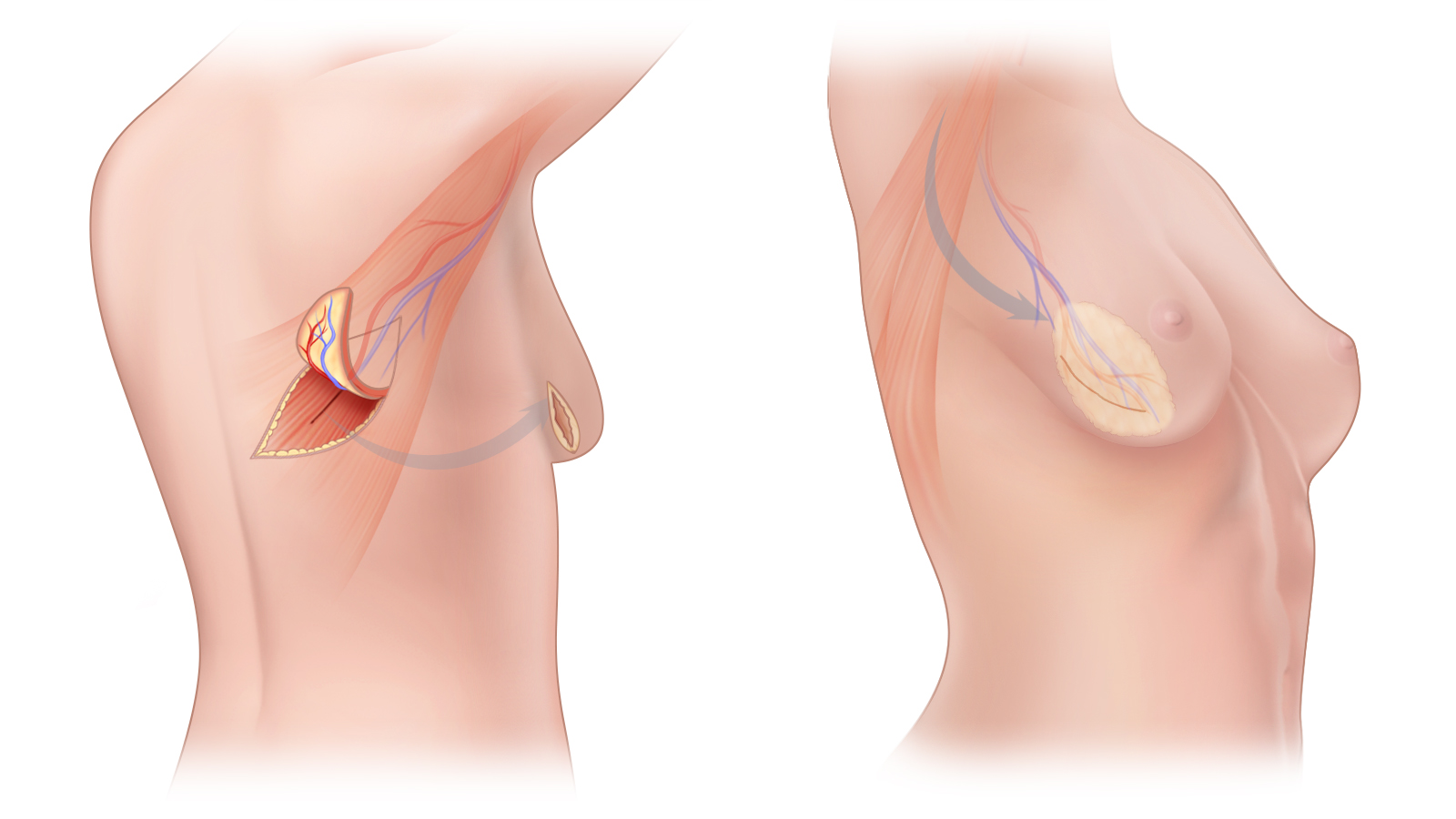
(A) The TDAP flap is a perforator flap composed of skin and fat harvested from the upper back. The blood vessels that supply this flap are meticulously separated from the latissimus dorsi muscle so that muscle is not sacrificed and strength in the arm and shoulder are preserved. (B) The TDAP flap is rotated and “tunneled” under the skin from the back to the chest; microsurgery is not necessary. This flap is commonly used for partial breast reconstruction following lumpectomy and for adding natural tissue to improve the result of a prior breast reconstruction.
(A) The TDAP flap is a perforator flap composed of skin and fat harvested from the upper back. The blood vessels that supply this flap are meticulously separated from the latissimus dorsi muscle so that muscle is not sacrificed and strength in the arm and shoulder are preserved. (B) The TDAP flap is rotated and “tunneled” under the skin from the back to the chest; microsurgery is not necessary. This flap is commonly used for partial breast reconstruction following lumpectomy and for adding natural tissue to improve the result of a prior breast reconstruction.
The Thoracodorsal Artery Perforator flap, known as a TDAP or TAP flap, is a perforator flap that can be rotated from the upper back in to a position on the chest wall for use in breast reconstruction. TDAP flaps are composed of skin and fat along with the blood vessels that keep the flap alive. These flaps are obtained from the same region of the back as the latissimus dorsi flap, however, no muscle is sacrificed with a TDAP flap. Because these flaps are rotated into place without having to divide and reattach blood vessels, it is not necessary to use the operating room microscope, and most patients only require one night of hospitalization. The preparation of a TDAP flap requires meticulous dissection under loupe magnification. Unfortunately, these flaps are not widely offered as an option to women undergoing breast reconstruction.
Although most women do not have enough tissue on the upper back to enable the surgeon to use TDAP flaps alone for breast reconstruction after mastectomy, these flaps are an excellent way to supplement an existing breast reconstruction with additional volume without the need for breast implants or other kinds of flaps. TDAP flaps can also be used as an alternative to implants in the correction of tubular beast deformity and as an option for women who want to undergo breast augmentation using their own tissue. The scar that results from TDAP flaps can generally be placed horizontally along the bra line so that it can be covered up by a bra.
TDAP Flap Breast Reconstruction in New York and Connecticut
Contact us to schedule a consultation or if you would like more information about the options for breast reconstruction after mastectomy including TUG flaps, DIEP flaps, SIEA flaps and SGAP flaps. Our practice has offices in Manhattan and Greenwich, Connecticut.